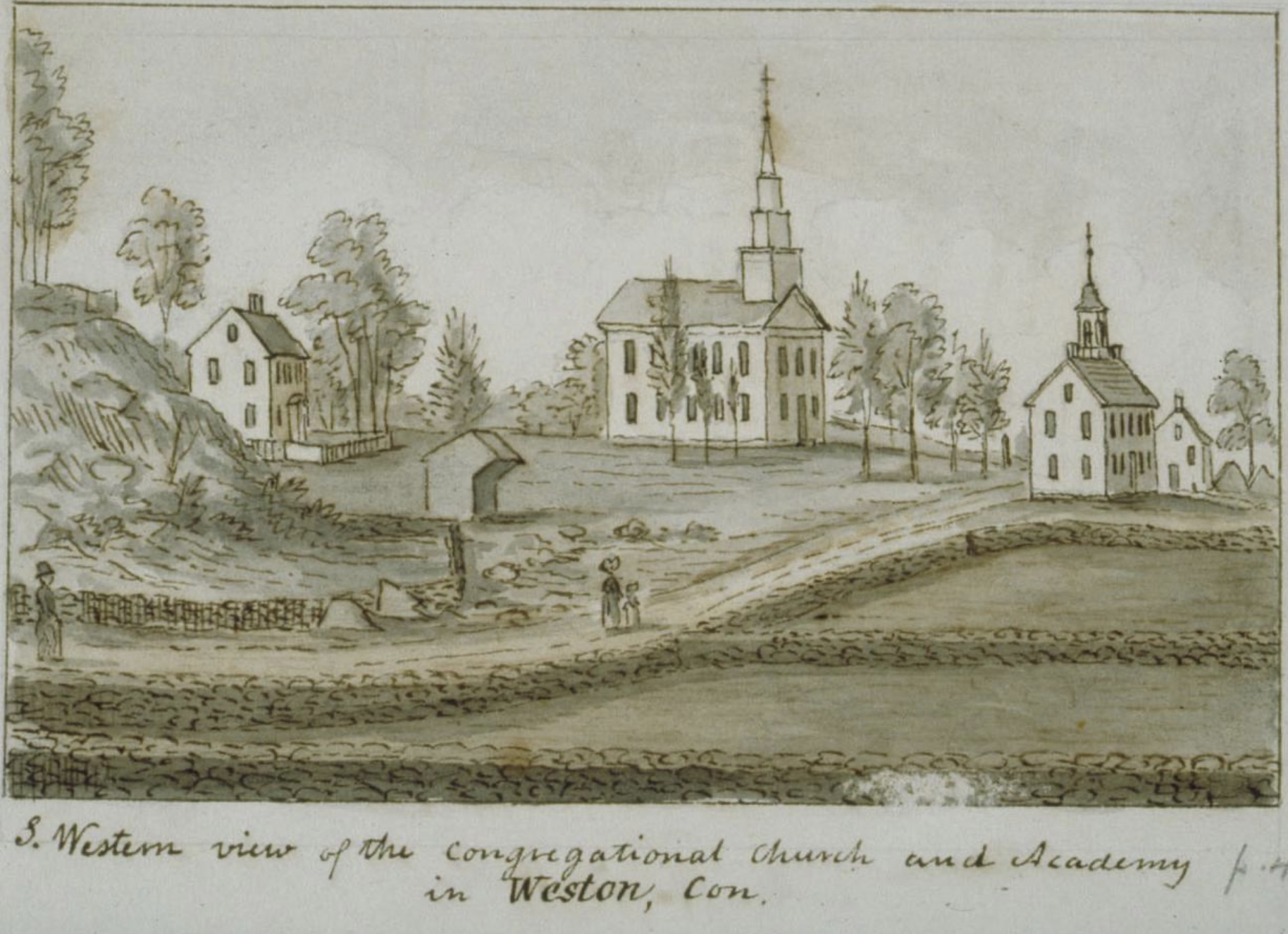
Prominently situated at the heart of the parish, the Staples Academy was designed as a stately two-story Greek Revival building. It certainly stood out as a point of local pride. For over 100 years, the Staples Free School ran as a free private academy, the second such institution established in the United States, preceded only by Phillips Exeter Academy in Massachusetts. Here, deserving pupils were instructed at no cost if they could not pay. Most students boarded in homes around town, and all were required “to attend Church on the Lord’s Day and behave with decency and attention.”
The school was immediately successful and became a major feeder for Yale University, with Staples students continuing in law, politics, science, and theology. Students traveled throughout Fairfield County and the entire state to study in Easton. Attracted by its excellence in education and rural settings, the school was dubbed the Staples Academy in local newspapers and it was described as a “quiet place, very well adapted to study and free of immoral influences.”

The Staples Academy was the earliest co-educational Academy in Connecticut, accepting girls at a time when higher education was not universally accepted for women. The school had many successful alumni, including teachers, lawyers, doctors, and businessmen, who were grateful for their formative education at the Staples Academy. One of these was Isaac Toucey, who, in 1810, applied for schooling as a charity scholar. He would go on to study law and he served as a state representative, a senator, governor of Connecticut, and attorney general of the United States. The success of its students established the Academy as one of the leading educational institutions in New England.
We know that the building underwent a substantial remodeling in the first ten years of the 19th century to accommodate its increased enrollment. Archives record that in 1800, the second story was taken down, and the rooms reconfigured to allow for the construction of an amphitheater, stage, and cupola. The amphitheater served as a lecture hall, allowing larger class sizes and accommodating student recitations, dramatics, and musical performances. It was also finely appointed, with seating appropriate for trustee and faculty meetings. This space not only served the school but it also functioned as the earliest known public performance space in the town, where literary societies and youth groups could host exhibitions and gatherings. This was particularly important as the town churches prohibited such activities under their roofs.
The Academy also became integral to our town’s governance and economy. Civic gatherings were often held in its hall, and in 1845, it was the location of the first Easton town meeting after Weston was divided. Not only did the school provide an assembly place, but it also benefited our town’s economy. Boarding students and teachers supplied additional income for local families, and the trustees managed the Staples Fund like a banking institution. They maintained the principal but used the dividends wisely. They granted loans to local farmers and businesses for capital improvements and oversaw a broad portfolio of investments. With one notable setback in 1825 when New Haven’s Eagle Bank failed, the trustees successfully managed their charge for a hundred years.
Enrollment diminished towards the close of the 19th century, and this was likely a reflection of several factors: state-run high schools in larger cities were drawing students away from smaller, rural schools, and the population of Easton had dwindled. The governing board also diminished as members passed away and were not replaced. The trustees in 1895 were Bennett Seeley and Joseph W. Johnson of Easton, along with Redding resident the Reverend W. J. Jennings. None of these men were young. Jennings passed away in 1895, followed by Johnson the following year. Bennett Seeley, the last survivor, did not see to his own successor even though he was in his seventies. The financial ledgers, which had been in Seeley’s hand and certified by his signature in previous years, abruptly stopped in July 1895. Dying in 1899, the gap between his last entry and death suggests he may have been unwell and unable to tend to the bookkeeping.
At some point in 1896, Percy Lincoln Johnson, the son of the late trustee Joseph W. Johnson, had unofficially taken over the care of the Staples Trust. Raised in Easton, Percy was an alumnus of the Staples School who studied at Wesleyan and Yale Law before joining the offices of Beers and Foster in Bridgeport.
When the record books pick up again in 1901, we learn there had been a terrible embezzlement scandal. From 1896 to 1900, Percy acted as though he were treasurer and he absconded with nearly all the school funds and transferred many of the Staples lands to himself. Promptly caught on the road as a fugitive, his trial was reported on by newspapers across the country. Percy was found guilty and sentenced to six years in prison.

The effects of the scandal and the financial loss for the Staples School in Easton were disastrous. New board members were officially sworn into office, and land titles taken by Percy were recovered. However, none of the cash funds were ever returned, and the school’s balance sheets were so depleted that it could barely afford the court fees associated with the trial.

The school closed during the winter of 1901, leaving its last teacher, William M. Gallup, with a claim for unpaid services. Though they were able to get back in the black, they failed to raise enough tuition and donations to reopen. Local papers mourned the loss of this long-standing institution that was home to so many generations of students.